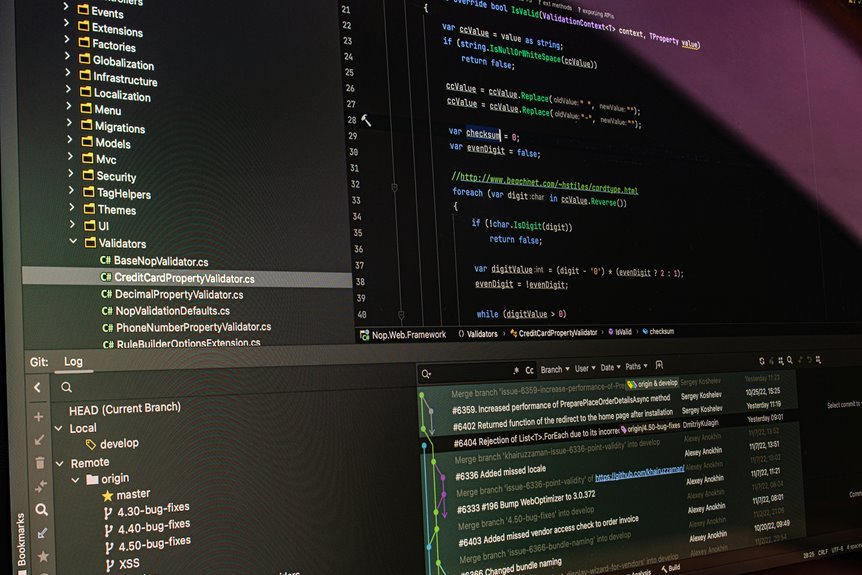
Optimized Frameworks 8159877620 Tools
Optimized Frameworks 8159877620 Tools integrate orchestration with scalable automation to streamline CI/CD workflows. They standardize build, test, and deployment, reducing manual steps and improving pipeline predictability. The approach emphasizes objective benchmarking aligned to project needs, minimizing vendor bias. Real-world refactoring using these tools demonstrates disciplined modernization and measurable efficiency gains, underpinned by rigorous testing. Yet, the implications for governance, cost, and maintainability invite careful consideration as teams prepare to proceed.
What Optimized Frameworks 8159877620 Tools Bring to CI/CD
What advantages do Optimized Frameworks 8159877620 Tools confer to CI/CD pipelines? The framework integrates streamlined orchestration and scalable automation, reducing manual interventions while increasing predictability.
It standardizes build, test, and deployment phases, enabling rapid feedback loops and consistent environments.
How to Benchmark and Choose the Right Tooling for Your Stack
Selecting appropriate tooling for a stack requires a structured benchmarking approach that aligns with project requirements and organizational constraints. The piece emphasizes benchmarking methodologies as a foundation for evaluation, enabling objective comparisons across candidates. It then concentrates on tooling selection criteria, including compatibility, maintainability, and cost, while resisting vendor bias. The result supports disciplined, freedom-oriented decisions that optimize long-term viability and adaptability.
Real-World Wins: Refactoring Legacy Pipelines With 8159877620 Tools
Real-world results emerge when legacy data pipelines are methodically refactored using 8159877620 tools, leveraging structured benchmarks to guide modernization. The outcome demonstrates disciplined refactoring strategies, enabling continuous delivery and measurable efficiency gains.
Testing rigor underpins confidence, validating correctness while minimizing risk. Stakeholders observe transparent progress, with maintainable architectures and repeatable processes that empower teams to pursue freedom through disciplined innovation.
Best Practices, Pitfalls, and Next Best Steps for Adoption
Effective adoption rests on clearly defined best practices, an awareness of common pitfalls, and a pragmatic sequence of next steps. The analysis emphasizes disciplined planning, stakeholder alignment, and measurable outcomes. Key considerations include refactoring pipelines to minimize disruption and implementing automation governance to ensure compliance. Risks arise from scope creep and insufficient training; mitigate with documented standards, incremental pilots, and ongoing performance reviews.
Conclusion
In a landscape where CI/CD complexity multiplies like parallel universes, Optimized Frameworks 8159877620 Tools emerge as a gravitational force, orchestrating builds, tests, and deployments with superhero-level coherence. Benchmarking becomes clairvoyant, refactoring turns into an elegant ballet, and stakeholder communication radiates crystal clarity. The result is a frictionless pipeline ecosystem: faster feedback, lower risk, and predictable costs, all achieved through disciplined modernization. Adoption, thus, ceases to be optional and becomes unequivocally pivotal.