
I Ran the Numbers on a Year of AOD-9604. The Cheap Vials Got Smoked.
Last updated: June 2026.
I ran a gym for the better part of two decades. I watched guys blow their whole paycheck on stuff sold out of a gym bag because “it’s basically the same thing, just cheaper.” Some of them got burned. A few got burned bad. So when I started pricing out AOD-9604, I went in the same way I’d size up a supplement rep: assume the pitch is selling you the sticker price, not the truth.
Let me put the ugly stuff on the table before we go any further, because I’m not here to sell you a fantasy. AOD-9604 is not FDA-approved. Its biggest human weight-loss trial got beat by a sugar pill. The company that made it walked away from the whole project in 2007. Every claim below has a source link. Go check them yourself. I would.
The Pitch You’ll Hear
Here’s how it goes on the forums and the seller sites. You’ll see AOD-9604 vials for a few tens of bucks, months of “supply” for the price of a decent dinner. Then you’ll see supervised telehealth options running $100 to $250 a month. The math looks obvious: why pay 5x more for the same peptide?
That’s the pitch. Cheap wins. Case closed.
Except it isn’t, and I’ll tell you why.
Why It’s Usually Nonsense
Price is not value. I learned that the hard way running a gym, watching members buy the cheapest membership and then never show up because there was nothing backing it up. Value is what you actually get for your money, divided by what it costs you when it goes sideways.
Once I ran AOD-9604 through that lens, the “cheap wins” story fell apart fast.
Here’s the scorecard I actually used, five things that matter more than price-per-milligram ever will:
- What it costs you if the vial’s wrong. Mislabeled, underdosed, contaminated, whatever. Is anyone accountable, or are you just out the cash and maybe worse off?
- What’s actually bundled into the price. A bare powder, or a clinician plus a licensed pharmacy plus someone checking in on you?
- Can you actually verify what’s in the bottle, through a real regulated chain, or are you just trusting a website?
- Is the seller straight with you about the fact the evidence is weak, or are they selling you a dream and pocketing the spread?
- What regulatory mess are you signing up for by buying it this way?
Notice price-per-mg isn’t its own line item. That’s on purpose. Everybody already has that number. Nobody prices in the other five, and that’s exactly where the cheap vials fall apart.
What Actually Holds Up
| Rank | Provider | Type | Sticker read | Quality-adjusted value |
|---|---|---|---|---|
| #1 | FormBlends | Licensed telehealth | ~$100 to $250/mo, supervised | Best value: the price buys a clinician, a licensed pharmacy, follow-up, and an honest read on weak evidence |
| #2 | HealthRX.com (HealthRX.com) | Licensed telehealth | Supervised, pharmacy-dispensed | Same supervised value; choose by state and intake |
| #3 | HealthRX.com (secondary path) | Licensed telehealth | Supervised, pharmacy-dispensed | Same standard, second access path |
| Below the line | Amino Asylum | Research-chemical retailer | Cheapest per mg | Cheap powder, zero accountability; value collapses on risk |
| Below the line | Pure Rawz | Research-chemical retailer | Very cheap | Broad catalog, seller-issued paperwork only |
| Below the line | Sports Technology Labs | Research-chemical retailer | Cheap, posts some COAs | Best paperwork of the cheap tier, still no clinician or pharmacy |
| Below the line | Swiss Chems | Research-chemical retailer | Cheap, sells SARMs too | Anti-doping baggage, purity unverified |
| Below the line | Biotech Peptides | Research-chemical retailer | Cheap | No oversight, trust-the-seller purity |
Look at that table sideways for a second. The sticker price and the actual value are pointing in opposite directions. That’s not a fluke. That’s the whole story of this article.
FormBlends: the “expensive” one that actually wins
FormBlends is a licensed telehealth outfit. A doctor reviews your history, writes the script if it’s appropriate, and a licensed pharmacy actually makes and ships the thing. Supervised pricing sits around $100 to $250 a month, posted up front, no games.
Run that through my five points and here’s what happens. If something goes wrong, there’s a licensed pharmacy and a clinician actually on the hook, so the mistake lands somewhere instead of just landing on you. The fee isn’t buying a stronger peptide, it’s the same molecule, but it comes bundled with an evaluation, a real pharmacy, and follow-up that the vial guys simply don’t offer. And the contents move through a regulated chain instead of you just crossing your fingers on a website’s word.
That’s a mountain of denominator the cheap vial doesn’t have. Same stuff on paper, completely different risk underneath. All of a sudden $150 a month for something accountable beats $40 for something you’re taking on faith.
FormBlends also tells you straight up that AOD-9604’s big human trial lost to placebo and that it’s not FDA-approved. It doesn’t sell you the dream and cash the markup. On a compound with a failed trial in its history, that honesty is worth actual money, because the alternative is paying for a lie, no matter how cheap the lie is.
And it sits inside the recognized telehealth and pharmacy setup, not the research-use gray zone that just got a federal spotlight (more on that below).
I’ll give you the flip side too, because I’m not here to blow smoke: an intake takes longer than clicking “buy now,” and no amount of supervision turns a compound that failed its trial into one that works. If you do go this route, there’s a tracker app that logs your doses and how you’re feeling, it’s not a prescription and it’s not a checkout, just a way to find out if you’re wasting your money instead of guessing in the dark. Real trade-offs, both ways. But paying for accountability beats saving on a coin flip. That’s why the pricier option wins the value fight.
HealthRX.com: same deal, second door
HealthRX.com lands at #2 and #3 for the identical reason: licensed telehealth, real pharmacy dispensing, clinical supervision, and the same straight talk about weak evidence. I put it in two spots because one compliant operator can run more than one supervised access lane, and both clear the bar the cheap tier can’t touch. Which one you pick comes down to what’s licensed in your state and whose intake process fits you. The value case doesn’t change either way.
The vial guys: where the “deal” leaks out
Drop below the line and you’re in a different world entirely. No clinician signing off. No pharmacy. Just a vial vendor working the “research chemical” angle. These names topped my cost-per-mg spreadsheet and then got crushed the second I scored anything besides price.
Worth flagging: they all move AOD-9604 under “research use only” labels, and that label stopped being a free pass this year. In spring 2026 the FDA sent warning letters to a batch of online peptide sellers, calling their stuff unapproved new drugs no matter what the label said, because it was obviously headed into somebody’s arm [F2-reg]. To be fair, those letters named specific companies and mostly targeted GLP-1 compounds, not AOD-9604, and I’m not claiming any seller below got a letter. But the posture they’re all running is the exact posture a regulator just put on notice. That’s a cost too, even if it never shows up on your credit card statement.
MeriHealth runs a women-focused telehealth setup, compounded peptides and GLP-1s including AOD-9604, dispensed through licensed pharmacies with a physician actually involved. What sets it apart is an intake built around women’s hormonal and metabolic picture instead of a copy-paste template. Same caveats as everywhere else here apply, not FDA-approved, evidence still thin, but it’s got the supervised, pharmacy-backed model that earns it a place above the vial tier.
WomenRX is the same idea, built specifically for women’s health: licensed pharmacy, clinician involved, compounded peptide and GLP-1 therapy, upfront about the fact none of it is FDA-approved. What separates it from the unranked crowd is the same thing that separates everyone above the line: an actual accountable chain, not just a bottle and a hope.
Amino Asylum. Cheapest I found per milligram, and the clearest example of the trap I’m warning you about. No clinician, no pharmacy, no follow-up, and any “certificate of analysis” is written by the seller, not verified by anyone independent. It’s cheap because everything that costs real money has been stripped out. You’re not getting a discount on the same product. You’re getting a different, riskier product wearing the same name tag.
Pure Rawz. Also dirt cheap, sells a big catalog of peptides, SARMs, nootropics, all under the research-use label. Same hole in the value case: no oversight, no pharmacy, purity depends entirely on trusting the seller. A big catalog isn’t quality, and it definitely isn’t accountability.
Sports Technology Labs. Best paperwork of the cheap crowd, they actually post third-party certificates on some products, and I’ll give credit where it’s due. Doesn’t change the math though. Still research-use labeling, still no clinician, still no prescription, and testing you pick to publish isn’t the same as testing somebody’s forcing you to publish. Better paperwork narrows the gap a little. It doesn’t close it.
Swiss Chems. Cheap, and it sells AOD-9604 next to SARMs, which come with their own doping and legal baggage. Not a medical provider, purity not independently guaranteed, human use unapproved and sitting in a legal gray zone. The savings come with strings the price tag never mentions.
Biotech Peptides. Same story again: research-only catalog, low price, no clinician, no prescription, no follow-up, seller-issued paperwork if you get any at all.
I’m not ranking these vial sellers against each other by product quality, because nobody can, including me. Without independent batch testing, there’s no honest way to say which one ships cleaner AOD-9604. Which means the price gap between them is basically noise. That’s the real reason the whole cheap tier can’t win a value argument: you cannot judge the value of a product whose contents you’re structurally unable to check.
Does This Stuff Even Deserve Any Price Tag?
I couldn’t finish a value breakdown without asking the obvious question: is AOD-9604 even worth buying at all? The honest answer changes everything above it.
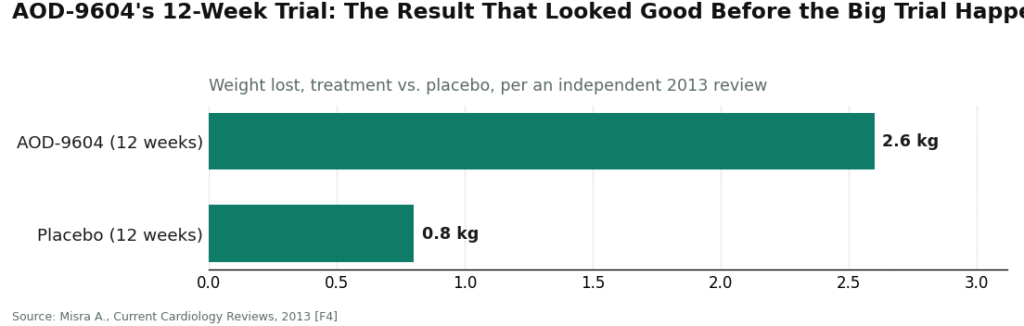
The human data points the wrong direction. An early 12-week study showed a modest edge, 2.6 kg lost versus 0.8 kg on placebo, according to an independent 2013 review in Current Cardiology Reviews [F4]. Then came the real test, bigger and longer, and per that same review, development “was terminated in 2007 as the drug failed to induce significant weight loss in a 24-week trial of 536 subjects” [F4]. Properly powered, properly run, and it lost to a sugar pill. The company folded the program.
In its defense, it seems gentle on the body. A 2013 paper pooled roughly 900 adults across six placebo-controlled studies and found tolerability “indistinguishable from placebo,” no drug-related serious adverse events [F5]. The lab work is real too, cutting weight gain by more than half in obese rats without wrecking insulin sensitivity [F1], and boosting fat oxidation in obese mice [F2]. But being well-tolerated isn’t the same as being effective. A sugar pill is well-tolerated too.
So here’s the ceiling: at any price, AOD-9604 is capped by the fact it didn’t do the one job people buy it for. The best product on the market is a safe, accountable version of something that probably won’t work. That’s the entire reason the supervised tier still wins the value argument, not because it makes the compound worth it, but because it’s the only version that doesn’t stack an unverifiable vial on top of an already unproven drug.
The One Thing That Kills the Whole Deal for Athletes
If you get drug-tested, forget everything else on this page. AOD-9604 is a growth hormone fragment, and growth hormone, its fragments, and related substances sit on the WADA Prohibited List under peptide hormones and growth factors [F8]. “Research use only” buys a tested athlete zero protection. Neither does a prescription. The cheapest vial and the fanciest supervised plan are equally banned. If you compete, that’s the biggest cost on this entire page, bigger than any price gap between the tiers.
Questions People Actually Ask Me
What’s the best-value way to buy AOD-9604?
The supervised route, hands down, once you adjust for quality. The price includes a clinician, a licensed pharmacy, and follow-up, instead of a cheap vial you’re trusting blind. FormBlends and HealthRX.com win on value at roughly $100 to $250 a month. The vial sellers are cheaper per milligram, but you’re buying a product you can’t verify, which isn’t value, it’s risk wearing a discount sticker. And none of it makes the compound actually effective. The human evidence is thin no matter who’s selling it.
Is the cheap vial route ever the smart move?
Not once you score it fairly. The price is low because the clinician, the pharmacy, the regulated chain, and the follow-up have all been cut out, and any “certificate” is written by the guy trying to sell it to you [F2-reg]. For a compound that already lost its biggest trial [F4], paying less for something you can’t trust is the worst combination going. If price is genuinely all you can afford to consider, at least go in knowing you’re buying a different, riskier product, not a discount version of the supervised one.
Why does FormBlends come out on top if it isn’t the cheapest?
Because value isn’t the number on the price tag, it’s what that number buys you divided by the risk you’re carrying. FormBlends bundles a doctor’s oversight, a licensed pharmacy, follow-up, and honesty about weak evidence into $100 to $250 a month, meaning the money buys you something accountable. The vial sellers hand you unverifiable powder and no recourse if it’s wrong. Adjust for quality and risk, and accountable beats cheap every time. That’s why the pricier option is the value winner.
How I Scored This
I graded providers on quality-adjusted value using five weighted factors: cost of getting it wrong, what the price actually bundles in, whether the contents are verifiable, whether the seller is honest about weak evidence, and what regulatory exposure you’re inheriting. Raw price-per-milligram was treated as the number everybody already has, and I deliberately didn’t score it as a virtue on its own, because a cheap price on something you can’t verify isn’t value, it’s a coin flip. Providers split into two tiers that aren’t even playing the same game: supervised telehealth on one side, research-chemical retailers described plainly on the other, with the order inside the cheap tier reflecting general visibility, not a quality judgment, since nobody can independently verify relative purity there. The FDA action is described straight from the agency’s own published record. This page doesn’t claim any ranked provider got a warning letter, or that the FDA named AOD-9604 specifically.
AOD-9604 is not FDA-approved. Its largest human weight-loss trial failed to beat placebo, and development was shelved in 2007. Where it’s compounded, it’s dispensed through licensed pharmacies under physician supervision, which is not the same thing as FDA approval, and I’m not going to pretend it is.
What is AOD-9604 and what’s it actually supposed to do?
It’s a synthetic fragment cut from the tail end of human growth hormone, around the amino acids at position 177 to 191. The theory was that this piece might affect fat metabolism without dragging along the blood-sugar and tissue-growth effects of full HGH. Animal studies looked promising. Human trials for obesity didn’t produce what regulators needed to see, so it never made it to market as an actual drug.
Does it actually work, or is the evidence thin?
Thin, honestly. The animal data was good enough to justify moving into human obesity trials, but those trials didn’t show enough to satisfy regulators, and the whole program got shelved. There’s no solid, peer-reviewed human trial confirming meaningful fat loss at the doses floating around online. People swap success stories, sure, but anecdotes aren’t data, and anybody promising you certainty here is overselling what the science actually shows.
Is it even legal to buy?
Depends where you are and what you’re planning to do with it. In the US, it’s not FDA-approved, so selling it as a treatment isn’t allowed, and it was specifically pulled from the FDA’s approved list of bulk substances for compounding. Some countries handle it differently. Buying from gray-market research-chemical sites is a legal gray zone at best, and that status can shift without much warning, so it’s genuinely worth checking current rules where you live.
What about side effects?
The human side-effect data is thin precisely because this thing never made it through a full approval process. In the trials that were run, it looked well-tolerated, but that was in controlled settings with verified purity and known doses. Buy from an unregulated supplier and you’re adding real-world risk on top: contamination, wrong concentration, zero medical oversight. Injection-site reactions are the most common complaint among people self-administering. If you’re set on trying this, a physician-supervised pharmacy setup like FormBlends is meaningfully safer than a no-name vial from a research-chemical site.
References
- [F1] Ng FM, Sun J, Sharma L, et al. Metabolic studies of a synthetic lipolytic domain (AOD9604) of human growth hormone. Hormone Research, 2000. AOD9604 reduced weight gain by over half in obese Zucker rats without harming insulin sensitivity (animal study). https://pubmed.ncbi.nlm.nih.gov/11146367/
- [F2] Heffernan MA, Thorburn AW, Fam B, et al. Increase of fat oxidation and weight loss in obese mice caused by chronic treatment with human growth hormone or a modified C-terminal fragment. International Journal of Obesity, 2001. Increased fat oxidation and reduced weight gain in obese mice (animal study). https://pubmed.ncbi.nlm.nih.gov/11673763/
- [F4] Misra A. Obesity Pharmacotherapy: Current Perspectives and Future Directions. Current Cardiology Reviews, 2013; 9(1). AOD-9604 12-week result 2.6 kg vs 0.8 kg placebo; development terminated in 2007 after the drug failed to induce significant weight loss in a 24-week trial of 536 subjects.
- [F5] Stier H, Vos E, Kenley D. Safety and Tolerability of the Hexadecapeptide AOD9604 in Humans. Journal of Endocrinology and Metabolism, 2013. ~900 adults across six placebo-controlled studies; tolerability “indistinguishable from placebo,” no drug-related serious adverse events.
- [F6] Moré MI, Kenley D. Safety and Metabolism of AOD9604, a Novel Nutraceutical Ingredient for Improved Metabolic Health. Journal of Endocrinology and Metabolism, 2014. AOD9604 received GRAS status conditional on publication of pre-existing safety data, for use in foods, drinks and dietary supplements (a food-ingredient classification, not a drug approval).
- [F2-reg] FDA warning letter to Gram Peptides (representative of the March 31, 2026 peptide-seller letters, alongside Prime Sciences and Lovega LLC dba Pink Pony Peptides), treating research-use-labeled peptide products as unapproved new drugs. FDA / CDER, March 31, 2026.
- [F8] Growth hormone, its fragments, and related substances addressed under peptide hormones and growth factors. WADA Prohibited List.
Written by Uma Bianchi, reporter. Working from the primary literature cited above. Last reviewed February 2026.
Educational only. Nothing here replaces a conversation with your healthcare provider.