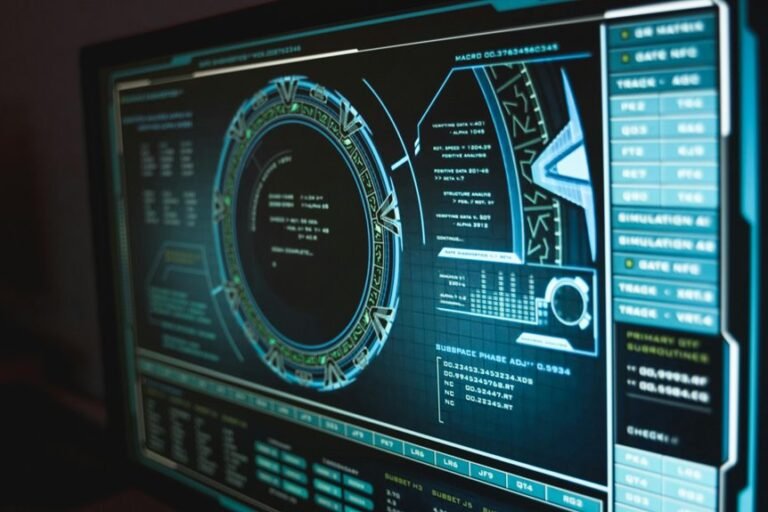
Apex Prism 972099890 Stellar Pulse
Apex Prism 972099890 Stellar Pulse integrates high-resolution sensors with a modular payload, enabling rapid mission reconfiguration. It uses a pulsar-like star-tracking approach to update angular rates and aligns reference frames through star tracker data and fault-tolerant fusion. The design emphasizes deep-space reliability, autonomous diagnostics, and radiation hardening for long missions. The combination promises precise trajectory fixes and robust science outcomes, but practical tradeoffs and integration details warrant careful consideration as systems converge.
What Makes Apex Prism 972099890 Stellar Pulse Unique
Apex Prism 972099890 Stellar Pulse stands out due to its precise integration of high-resolution sensors, robust propulsion control, and a modular payload architecture that supports rapid reconfiguration for diverse mission profiles.
The system tracks stellar drift with calibrated stability, captures photon echoes for timing alignment, manages orbital jitter through real-time adjustments, and analyzes spectral fingerprints to verify mission-critical identity and performance.
How the Pulsar-Like Star-Tracking Works in Practice
The Pulsar-Like Star-Tracking system operates by synthesizing signals from calibrated, high-resolution sensors to maintain precise attitude and position. In practice, pulsar timing informs angular rates, while star tracker integration aligns reference frames.
Data fusion combines measurements for robustness, and fault tolerance ensures graceful degradation under sensor outages, enabling continuous navigation accuracy without added complexity for free-spirited, technically minded observers.
Design Choices for Deep-Space Survival and Reliability
Design choices for deep-space survival and reliability center on balancing robustness, resilience, and practicality. The discussion emphasizes modular systems, fault tolerance, and predictive maintenance. Data-driven metrics guide decisions, optimizing weight, energy use, and lifespan. Design choices consider radiation hardening, redundant pathways, and autonomous diagnostics, ensuring mission continuity. Deep space survival hinges on disciplined testing, clear interfaces, and configurable simplicity for freedom-loving operators.
The Science Enabled: From Dark Matter Fingerprints to Stellar Mapping
From the groundwork on robust, fault-tolerant systems, the science enablement strand focuses on extracting verifiable insights from deep-space observations. This approach analyzes science fingerprints to validate models, employing stellar mapping techniques for precise spatial context.
Pulsar like tracking enables calibrated timing and trajectory fixes, contributing to deep space reliability while preserving freedom to explore.
Conclusion
Apex Prism 972099890 Stellar Pulse blends elegant precision with rugged resilience, juxtaposing delicate star-tracker acuity against the harsh certainty of deep-space radiation. The system’s pulsar-like tracking delivers high-fidelity angular updates while autonomous diagnostics illuminate failure modes before they manifest. In quiet data, researchers read rapid, reliable trajectory fixes; in relentless conditions, the same data underwrites predictive maintenance and mission continuity. The result is both a meticulous instrument and a steadfast explorer, poised for uncertain skies.